 ×
Both bromadiolone and brodifacoum are second-generation anticoagulants, and both will be offered to you by suppliers who describe them in almost identical language. The differences that matter to a distributor or PCO are narrower and more specific than the marketing suggests: how the two actives are chemically related and where that difference stops mattering, how the bait matrix behaves in a hot and humid warehouse, what the destination market's label actually permits, and what the program must do about resistance and non-target exposure. This guide sets those four questions out in the order a purchasing decision runs, so that the comparison you make is against your program's constraints rather than against a spec sheet. It is written for importers, distributors and PCO teams buying for African and Southeast Asian markets, where humidity, registration scope and site sensitivity usually decide the outcome before price does.
Anticoagulant rodenticides did not begin as second-generation chemistry. WHO/IPCS records that the first-generation hydroxycoumarins were introduced as rodenticides in the late 1940s, and that the appearance of resistance to warfarin and related compounds drove the development of more potent second-generation anticoagulants. That origin explains why the class dominates professional bait programs: it was designed around a resistance problem, not a marketing opportunity.
That history is also why the class reaches the market in several vocabularies at once. The same drum can be described as an anticoagulant rodenticide on the technical sheet, a rodenticide rat poison in the retail channel, and a bromadiolone rat killer or bromadiolone mouse poison on a shelf label. The wording is negotiated downstream of the registration; the label registered for the destination market is the document that governs use.
The operational advantage is behavioral rather than chemical. Anticoagulants act with a delay, so rodents do not associate the bait with the onset of symptoms, which is why bait shyness is manageable rather than fatal. A fast-acting compound in a warehouse with a resident population teaches the survivors to avoid bait, and you lose the second and third weeks of a program that depends on continued acceptance.
The limitation is equally structural. Action is delayed, so a program must run long enough for the baiting period on the label to be completed, and labor continues while the population declines — carcass inspection, bait point checks, replenishment, non-target monitoring. Procurement teams who price a program on bait cost alone understate it. The class also carries the risk that makes it effective: non-target animals and pets share the same mechanism, so it is inseparable from the protection measures in section five.
Both actives are vitamin K antagonists. WHO/IPCS Environmental Health Criteria 175 covers vitamin K and its antagonists together, and the mechanism explains why the label carries a vitamin K1 entry: the compounds interfere with the vitamin K cycle that produces the active form of the clotting factors, so coagulation capacity falls rather than fails instantly. That interference is reversible by vitamin K1 — a statement about pharmacology, not about treatment. Any suspected exposure in humans or animals is a clinical matter for a medical professional or a poison center, and nothing here is treatment guidance.
The mechanism is shared, and so is its consequence. EHC 175 explains the greater potency of second-generation anticoagulants partly by their highly lipophilic nature and by the very slow dissociation of the enzyme-inhibitor complex — a class-level explanation, not a ranking within the class. For a buyer the consequence is concrete: response is delayed, so the observation window and the reapplication interval come from the label, not from a guess about which acts first.
Four selection criteria follow.
Resistance history first. A documented history of poor results with first-generation compounds settles the class question and narrows the choice to which second-generation active, at what interval, with what monitoring. Where the history is unknown, a baseline is worth more than a comparison table.
Site sensitivity second. A food hall, grain store, livestock unit and drainage line present different non-target exposure routes. Where pets, poultry, livestock or children can reach a bait point, tamper-resistant placement and carcass removal matter more than any difference between the actives.
Matrix compatibility third. The active must arrive in a matrix the local population will actually eat; a formulation rejected in a humid store performs like no product at all.
Documentation fourth. The label approved for the destination market defines what you may do; the specification sheet defines what you are buying. Neither substitutes for the other.
This guide makes no comparative claim about how quickly either active reduces a population, or about which is stronger; those are label-and-program questions.
Grain baits work because they look and smell like food. That is also their weakness: agricultural material reacts to the environment. Format choice is a site-survival decision before a preference.
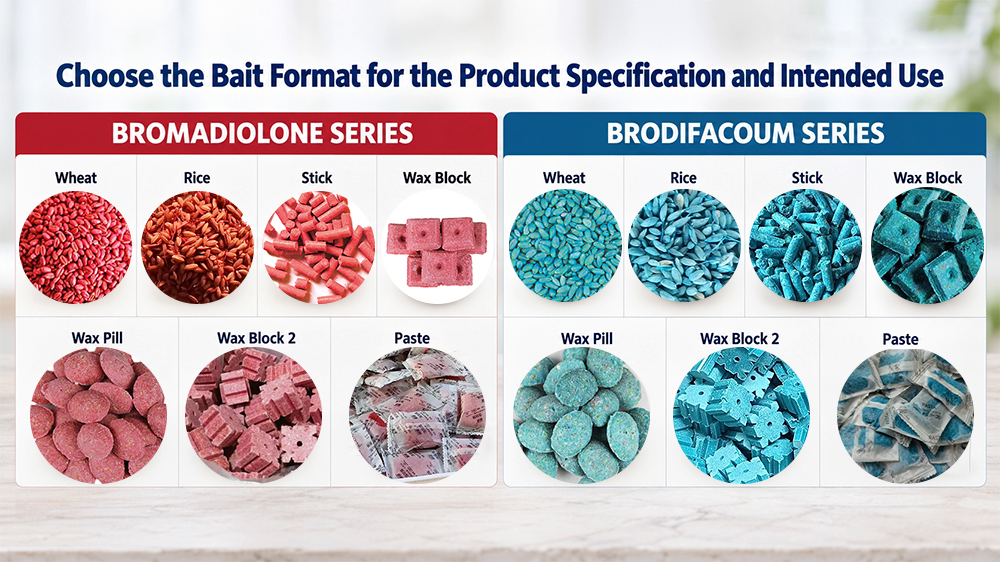
Format and active are independent choices in this range. Both actives are available in all seven formats, subject to order specification and destination-market registration, so a program can change format without changing active, and active without re-engineering its baiting.
|
Format |
Form |
Application Scenarios |
|
Whole wheat |
Loose grain |
Dry, sheltered sites with a grain-eating population; the common default |
|
Whole rice |
Loose grain |
Markets where rice is the familiar food base: much of Southeast Asia and West Africa |
|
Strip |
Extruded strips |
Runways and burrow mouths where loose grain is displaced |
|
Wax pellet |
Pressed pellet |
Uneven surfaces and humid service areas |
|
Wax block (flat) |
Pressed flat block |
Drains, wet areas and outdoor placements that defeat loose grain |
|
Wax block (apertured) |
Pressed block with a central hole |
Placements where a block must be fixed rather than laid loose |
|
Paste |
Sachet |
Dusty, dry or high-moisture sites; convenient for tracking uptake point by point |
Moisture is the dividing line: loose grain carries the highest acceptance and the least tolerance of humidity, while wax formats are built for placements where loose grain fails. A strip in a runway and a block in a drain answer different problems.
The warning color belongs in the specification: it is how a buyer and an auditor tell the actives apart on sight — bromadiolone red, brodifacoum blue in this range. Confirm the coding against the destination label, not a photograph.
Palatability cannot be verified from a specification table. Three checks narrow the risk: run a current sample at representative sites; inspect each arrival batch for dust, damage and off-odor; and rotate stock on receipt, since bait that has sat in a hot container for months is not the product you tested.
Heat and humidity combine badly: heat shortens bait's useful life, and humidity reaches loose grain before wax. A buyer in Mombasa, Lagos, Dar es Salaam or Jakarta should treat storage and transit as part of the specification, and confirm how the supplier packs for humidity: sealed sachets and drums are not cosmetic.
The label is the only document that tells you what you may lawfully do, and it is the one most often summarized badly in a quotation. Read six elements before comparing prices.
Authorized target species. Species coverage is stated, not implied. A product registered for rats is not automatically registered for mice at the same rate, and the difference matters in a grain store where both are present.
Permitted use sites. Indoor only or indoor and outdoor; food premises or not; around buildings or in field margins — a bait suitable for a warehouse perimeter may be prohibited inside a processing hall.
Application rate and baiting point layout. These are label values, not transferable between products, matrices or markets. Take the rate and placement pattern from the approved label, not from a supplier's summary. More bait than the label allows does not compensate for poor placement.
Reapplication interval. Slow action means points must stay available long enough for repeated encounters, and the interval at which points are inspected and replenished is a label and program matter. Consumption records are your earliest indicator that placement is wrong.
Non-target safeguards built into the product. A bittering agent and a warning color are handling aids, not substitutes for secure placement; confirm both in the batch you buy, because they are what a substitution or repack most often drops.
Registration status for the destination market. A product registered in one country is not thereby registered in another. Confirm the status and the approved label text for the market you ship to, and treat any registration statement as a document to verify.
Baiting points belong to the program, not the product. Placement along walls, at burrow entrances, in corners and behind equipment is governed by the label and the site survey; fixed, protected and tamper-resistant points are the norm wherever people or non-targets can reach. Bait stations and protective boxes are program equipment, not part of the bait.
These topics are usually written separately. They belong together: the same three decisions — where bait goes, how long it stays, what gets recorded — determine both outcomes.
Resistance. EHC 175 documents the mechanisms that matter practically: reduced sensitivity of vitamin K epoxide hydrolase to inhibition, greater reversibility of that inhibition, and faster clearance of the compound, with the mechanism differing between strains. EHC 175 cites studies of resistance to second-generation compounds in its references, though its main resistance discussion concerns the first-generation coumarins — which is why local data outranks any general statement. No active is permanently immune, and continued use of the same active ingredient may contribute to selection pressure — the condition a program later pays to fix. Resistance management should be guided by local monitoring and documented treatment outcomes, and rotation without local data is a preference rather than a decision.
WHO's vector control guidance combines methods rather than substituting one for another, and the same logic applies here: exclusion, sanitation, harborage removal and baiting work together, with the non-chemical measures reducing the selection pressure that baiting alone creates. Where response declines, check placement and consumption first, confirm resistance with the local technical authority, then change active.
Non-target protection and secondary poisoning. EHC 175 states the risk directly: rodenticides present a risk not only of primary poisoning from direct bait consumption but also of secondary poisoning from consumption of poisoned rodents, and poisoned commensal rodents have been linked to deaths of cats, pigs, foxes and birds of prey. Two recommendations from the same source belong in a contract: killed rodents should be disposed of as the local authority requires — by burning or burial where those are permitted — to reduce the risk of secondary poisoning of predators, and training in the safe handling of rodenticides is essential.
In practice that becomes five standing rules. Bait goes into protected, tamper-resistant points wherever people, pets, poultry or livestock can reach it. Carcass search and disposal is scheduled work with a named owner. Warning signage and bait point mapping stay current, because an unrecorded bait point is an uncontrolled one. Bait is stored locked and away from feed, food and water. Every exposure incident — human or animal — goes immediately to a medical professional or poison center, with the label and SDS available; the vitamin K1 entry explains the mechanism and authorizes no one in the supply chain to advise on treatment.
Conclusion
Choosing between bromadiolone and brodifacoum is a four-part decision: what the local resistance history allows, what the site permits for non-target protection, which matrix survives your storage, and which documents your market requires. Confirm those in writing, then compare price — not the other way around.
Wholesale & Distribution Partnership Inquiry — Jiebao Biotech supplies YUKANG second-generation anticoagulant rodenticide baits in seven formats, from whole grain to wax block and paste, for distributors, PCO companies and professional buyers across Africa and Southeast Asia, with OEM and private-label support. Contact our team for available product specifications, packaging options, applicable label documents and quotation details, or review the full rodenticide range.

SHANDONG JIE BAO BIOTECHNOLOGY CO.,LTD provides professional OEM/ODM pest control solutions for global distributors and PCO companies. 25+ years’ expertise, 100+ formulations, ISO 9001-certified. Request custom insecticide solutions today.
West of West Latitude Road, Yong'an Town, Kenli District, Dongying City, Shandong Province, China
Copyright © 2026 by SHANDONG JIE BAO BIOTECHNOLOGY CO.,LTD Privacy Policy

 EN



 Hot News